




An accelerator gets you started. A platform keeps you fast.
SAP Composable Storefront (previously Spartacus) gets your first storefront live, but Alokai keeps you fast on the hundredth change, because you get the storefront, written in React (Next.js) or Vue (Nuxt) instead of Angular, plus the full platform underneath it: the UI library, BFF, infrastructure, analytics, and AI. Everything you build next ships faster, all on the same SAP Commerce Cloud backend.
Six reasons teams choose Alokai over SAP Composable Storefront
SAP Composable Storefront gives you a baseline storefront. Alokai gives you a foundation that compounds. Here is where that shows up.

Add the hundredth feature as cleanly as the first
SAP Composable Storefront gives you a baseline, but it runs out where your real requirements begin. Alokai is built on a composable foundation with proven patterns, so everything custom you add inherits the same quality and keeps performing as the storefront grows.

Swap any backend without rebuilding the frontend
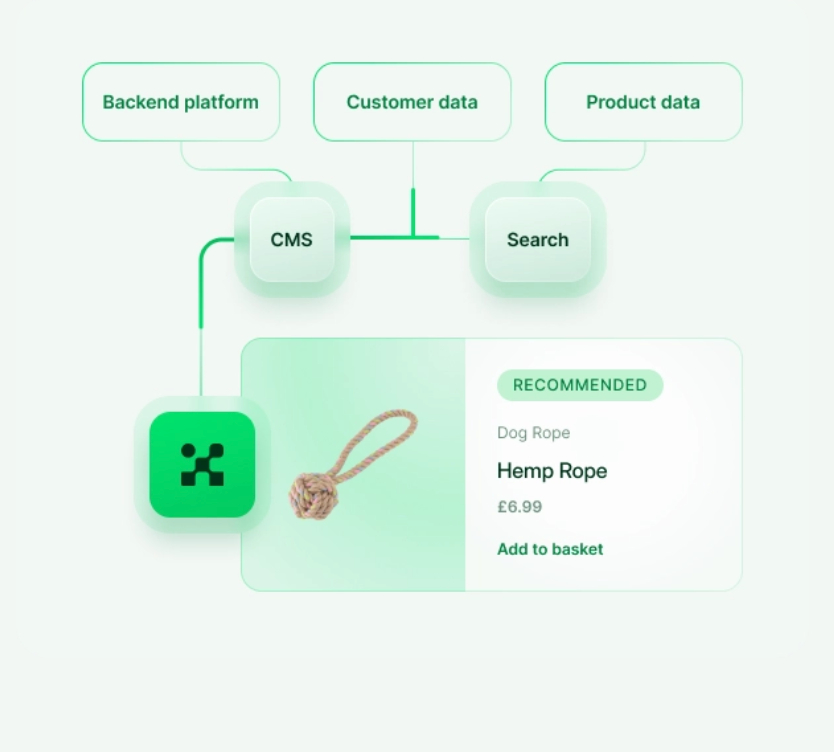
Alokai comes with ready-made integrations for leading backends, CMSs, search, and payments, including Contentful, Contentstack, Bloomreach, and Coveo, and you can connect any PIM or ERP through Connect. Because the Unified Data Layer sits in between, swapping a vendor is a config change rather than a rebuild. SAP Composable Storefront only integrates with the SAP family.

A foundation built for performance, not a ceiling
SAP Composable Storefront ships a lot of framework code of its own, and that sets a performance ceiling: you start from a mediocre baseline, and every feature you add makes it worse. Alokai keeps the storefront lightweight by doing the heavy work server-side on the BFF, so you get a fast foundation with real room to build great performance on, instead of fighting a ceiling from day one.

Ship new brands and regions in days, not weeks
Most storefronts share 60 to 80% of their functionality, so Alokai reuses that common core through file inheritance, where each store overrides only what it needs and inherits the rest. You keep one codebase and still customize per brand where it matters. That is how teams launch new stores around 50% faster, as Berlin Brands Group has across 28 countries and 45 brands.

Turn your storefront into one that adapts and improves itself
Alokai is AI-native by design. Compass makes the storefront adapt to each shopper, AI coding helps your team move faster, and Commerce Intelligence learns from your data to keep improving results. SAP Composable Storefront has no native storefront AI framework. Compass can add one to it, and only the full Alokai stack fuses interface and data into one intelligent system.

Get a platform someone is accountable for
Alokai backs the platform with a 99.9% SLA and a dedicated Solutions Architect through IMPACT Services, along with a private Slack channel and free workshops. SAP Composable Storefront has historically shipped without a defined SLA, which leaves availability on you. You get a platform someone maintains with you, not a repository you own alone.
The whole platform, not just a storefront
SAP Composable Storefront gives you the frontend storefront layer. Hosting, integrations, monitoring, analytics, and AI are all yours to source and run. With Alokai they come together as one platform.
Your store works fine. That's why the cost stays hidden.
We benchmarked 200+ live SAP Composable Storefront (previously Spartacus) sites on mobile. The two numbers below are the average, and almost every site scores about the same, no matter who built it.
Average mobile Lighthouse score
pass Google’s Core Web Vitals
Source: Alokai benchmark of 200+ public SAP Composable Storefront sites, 2026. Demo scores are single measured mobile Lighthouse runs; scores vary between runs.
What that slowness costs
- +8.4%
- higher conversion, plus 9.2% higher average order value, from a single 0.1s improvement in load time.
- 1%
- of sales lost for every 100 milliseconds of added latency, in Amazon’s own testing.
- 20–42%
- the conversion lift teams report after moving to a modern, lightweight frontend.
Google & Deloitte, “Milliseconds Make Millions”
Amazon
Composable migration benchmarks
Spartacus caps your performance low from the start. Alokai isn't bound by it.
Both demos ran the same mobile Lighthouse test, and both are full storefronts, not stripped-back shells. Spartacus scores lower because of how it's built: a heavy JavaScript bundle it can't shed, so teams fight the framework for every point instead of following it. Great performance comes from the architecture underneath, a BFF and a cloud doing the heavy lifting, which an accelerator doesn't have. You need a platform, not an accelerator.
Carolina Herrera came for the audit. They weren’t planning to replace their storefront.
Carolina Herrera, part of the PUIG group, wanted one thing: an independent read on their SAP Composable Storefront. We gave them that, including what they could fix without leaving. They moved to Alokai anyway, and two months after launch the results were already well past the KPIs they had set.
Pages Google now indexes
Every market finally has its own pages instead of one generic set.
Organic clicks from the US
Total organic clicks up 17%. The localised markets are where it compounded.
Localised click-through rate
Brazil doubled too, 0.6% to 1.1%.
Traffic to hero product pages
The pages that actually sell, in the markets that actually buy.
Your storefront in React or Vue, not Angular
Teams comparing Next.js with SAP Composable Storefront are really deciding between React and Angular. That choice shapes your upgrade calendar, who you can hire, and how much your AI tooling helps.
Upgrades on your roadmap, not on Angular’s calendar
Angular ships a major release every year and supports each one for 24 months, so an Angular storefront takes a major upgrade on Angular’s schedule just to stay supported. React has shipped four majors since 2017, one of them with no API changes at all, and Vue’s last major came in 2020. That upgrade time goes back into your roadmap.
A hiring pool more than twice the size
More than twice as many developers work in React as in Angular: 44.7% against 18.2% in the Stack Overflow Developer Survey 2025. That gap shows up in every storefront role you try to fill: more candidates, faster hiring, less dependence on a single specialty.
More leverage from AI coding tools
AI coding assistants do their best work where public code and working examples are most abundant, and no frontend framework has more of them than React. Alokai adds typed contracts and version-matched context on top, so what the AI writes lands on-pattern in your codebase.
SAP Composable Storefront wasn’t built for the agentic era. Alokai was.
Composable was Gen 2, the standard the industry settled on. Agentic is Gen 3, where commerce is heading, and a frozen Angular storefront has nowhere to put it.
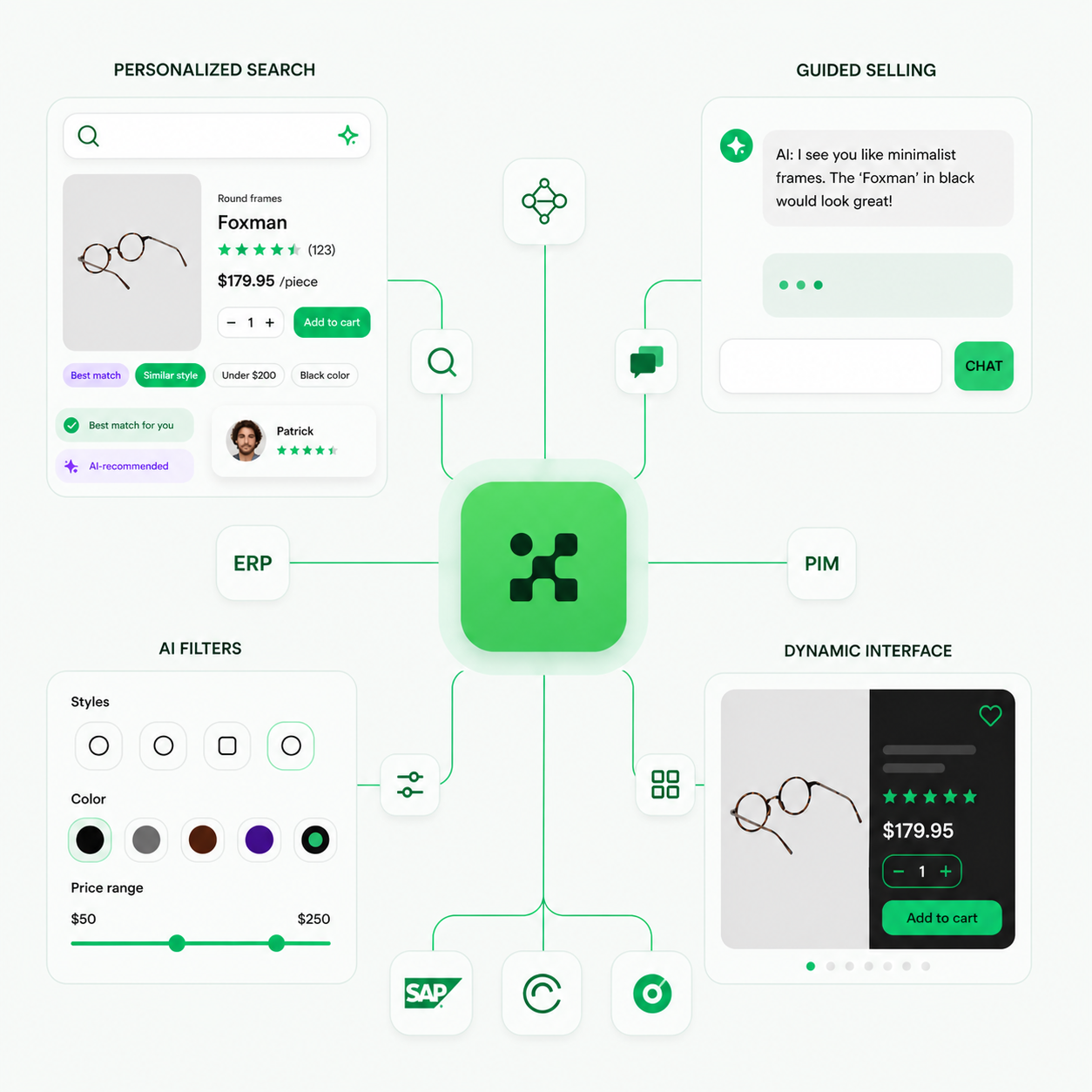
Alokai Compass builds intelligence into search, navigation, product pages, and checkout. It surfaces what shoppers struggle to put into words, helps them when they get stuck, and adjusts the interface as the session goes, so two visitors can end up with two different storefronts.
It isn’t a chat widget or a plugin. It’s AI-native by design.
AI at every step: build faster, convert more, improve continuously
Alokai’s AI isn’t a single feature. It works across the whole delivery cycle, helping developers ship faster, lifting conversion, and improving quality on its own.
Ship features faster with AI built for your developers
AI coding assistance helps your team build clean, on-pattern work in a fraction of the time. An accelerator hands you a template and leaves you to it. With Alokai, every build after the first one gets faster and cheaper.
Lift conversion with a storefront that adapts to every shopper
Compass reads what each shopper is trying to do across search, navigation, product pages, and checkout, using conversational discovery, recommendations, and a shared intent profile. The storefront adapts to each buyer as they go, so more visits turn into orders.
Raise quality automatically, without waiting on manual analysis
Commerce Intelligence watches your storefront data and flags issues on its own, connecting technical and business metrics in plain language. The storefront keeps getting better without anyone digging through dashboards.
How they compare, line by line
Same SAP Commerce Cloud backend. The difference is everything above it.
| SAP Composable Storefront | Alokai | |
|---|---|---|
| Architecture | Angular, API-driven via OCC/Commerce REST. Decoupled deployment but SAP-only ecosystem (Commerce Cloud backend, SmartEdit CMS). | Fully headless. Five independent layers: Storefront UI, SDK, Middleware (Connect), Console, Storefront. |
| Framework / performance | Angular with custom SSR (no native SSR). SEO needs extra config and tooling. | React (Next.js) or Vue (Nuxt) with native SSR and image optimization. Scores 90+ on Lighthouse out of the box. |
| Orchestration / BFF | No dedicated BFF layer. Frontend talks to SAP through OCC. | Connect is a production-grade BFF: data federation, caching, config switching, circuit breaking, error handling, logging. |
| Data model | Bound to SAP data shapes. | Unified Data Layer normalizes any backend, so multi-country and integration swaps do not ripple into the frontend. |
| Integrations | SAP family only (SmartEdit, Digital Payments, CDM Cloud). Well-documented but closed. | Best-of-breed / MACH (Contentful, Contentstack, Bloomreach, Coveo) plus any custom API, PIM, or ERP via Connect. |
| AI layer | No storefront AI framework. SAP Joule covers back-office, not the CX/storefront layer. | Compass sits on the middleware and consumes every connected API. Full AI dev framework, adaptive and self-improving. |
| Multistore | Multi-market setups surface in the frontend and become custom coordination work. | Multistore-first. One codebase via file inheritance, per-brand customization, 50% faster store launches. |
| Customization | Override CMS-mapped Angular components or use outlets. Full rebrand often means picking apart the template. | Direct source access at the Storefront layer, plus adaptable SDK and Middleware extensions. |
| Support / SLA | SAP enterprise support and paid training. Historically no defined SLA. | IMPACT Services: dedicated Solutions Architect, private Slack, free workshops, 99.9% SLA. |
| Best fit | Simpler stores that can run mostly on what the accelerator gives out of the box, without much custom work. | Teams that want performance, a best-of-breed stack, multistore at scale, and an AI-native storefront, plus the custom, demanding setups an accelerator can’t handle. |
Whichever storefront you pick, SAP Commerce Cloud stays your backend. What stays and what changes


Get the composable foundation you wanted, plus the AI layer SAP Composable Storefront never will.
Same SAP Commerce Cloud backend: keep your catalog, pricing, and promotions exactly where they are. See it in action on your own storefront, and we will show you where a lightweight AI-native frontend wins back performance, conversion, and speed-to-launch.